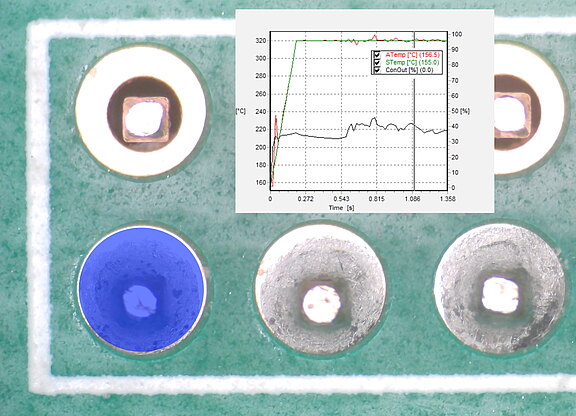
Example 1: – Laser brazing of a ceramic printed circuit board
The LASCON system prevents overheating and the formation of cracks in the printed circuit boardCustomer problem and requirement
A Tier 1 automotive supplier requires a laser brazing system for a critical ceramic circuit board:
- Prevention of cracks in the ceramic caused by the brazing process
- Maximum reliability and full process traceability for all brazing operations
- Support across all factories worldwide
The Mergenthaler solution
- LASCON controlled laser system with 60W light output. Integrated pyrometer with closed-loop control. Integrated precision wire feed
- LH103 laser head with laser, pyrometer and video port
- Accurate temperature control and an optimised soldering recipe to achieve process stability and prevent cracking
- Testing and optimisation were carried out in our own laser brazing laboratory
- Installation at the works by Mergenthaler
Current status
- The system has been running for over 20,000 hours: without interruption or repairs
- We are partners on numerous laser projects worldwide
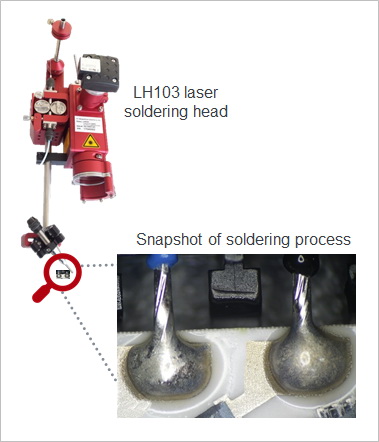
Example 2 – Laser brazing using a blue diode laser (445 nm)
The high absorption of blue laser light prevents burns on the circuit boardCustomer issue and requirement
When soldering through-hole components, the laser can easily burn the components underneath if the laser beam passes through the hole in the circuit board.
Reflectivity is particularly high in the case of through-hole plating.
However, damage to or melting of the electronic components is not acceptable.
The Mergenthaler solution
- Blue diode laser with a wavelength of 445 nm or 450 nm and 45 W optical power
- The absorption of blue laser light is significantly higher than that of a near-infrared laser. This prevents burns caused by reflection and allows the laser process to be controlled very effectively.
- A coaxial infrared pyrometer measures the temperature at the solder joint 10,000 times per second and controls the process
- The process runs smoothly and reproducibly